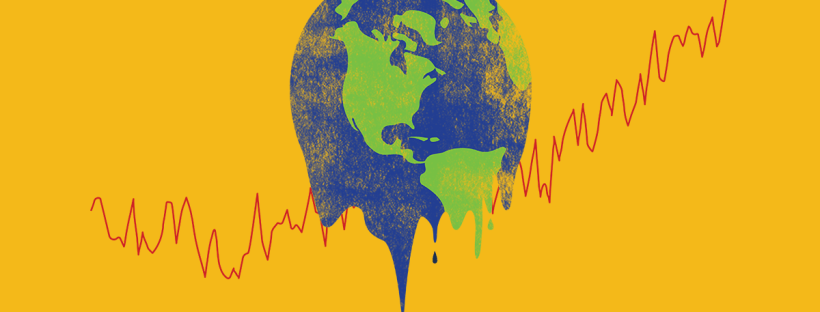
Research by Moore et al., (2019) studied social media discussions throughout the United States. They found that as communities experience more weather anomalies, the less remarkable these events become. This is compared to the boiling frog effect, which is a fable that describes a frog’s lack of danger awareness when it is introduced to gradually boiling water (Sedgwick, 1888).
One way to reduce this is to communicate less about individual anomalies. Instead, public education should focus on the broad picture of climate patterns over periods of thirty years or more, and connect these anomalies as supporting data points along that trend.
Another study, by Carmichael et al. (2017), talks about the echo chamber and boomerang effects when it comes to discussing climate change, and the role of media in perpetuating these. Partisan media may only reinforce what some people already believe about an issue as controversial as climate change as opposed to providing meaningful discourse about why there is opposition and how to address it. Continuing to do this actually harms the climate change movement because it fails to extend a bridge between two worldviews. It may amplify the boomerang effect, a phenomenon that makes some people dig their heels in further even when presented with compelling evidence about a topic they disagree with.
It is not surprising, yet still disheartening to see such a partisan divide from the study by Carmichael et al. (2017), especially now when our country is already so divided about many other subjects. When we consider climate being an intersectional issue that also impacts matters such as public health and socioeconomic well-being, it becomes even more crucial to try to see eye-to-eye.
When thinking about impacting perceptions about climate change, it may help to start small with just a few individuals. I find that the saying “you catch more bees with honey than with vinegar” helps people put their guards down. And I guess you could say that the general technicality of the boiling frog example works in this case too: if you expose someone to a dramatically opposing idea than they are used to in the years spent in their echo-chambers, the first response is to jump out of the pot and never return.
Moore, F. C., Obradovich, N., Lehner, F., & Baylis, P. (2019). Rapidly declining remarkability of temperature anomalies may obscure public perception of climate change. Proceedings of the National Academy of Sciences, 116(11), 4905-4910. doi:10.1073/pnas.1816541116
Carmichael, J. T., & Brulle, R. J. (2016). Elite cues, media coverage, and public concern: An integrated path analysis of public opinion on climate change, 2001–2013. Environmental Politics, 26(2), 232-252. doi:10.1080/09644016.2016.1263433
Photo by Melissa Joskow / Media Matters

 Literaria
In the context of Carmichael et al.’s (2017) study on the echo chamber and boomerang effects in climate change discussions, how can efforts be made to bridge the partisan divide and foster meaningful discourse that addresses opposition and contributes to a more united front in addressing climate-related challenges? Visit our Telkom University