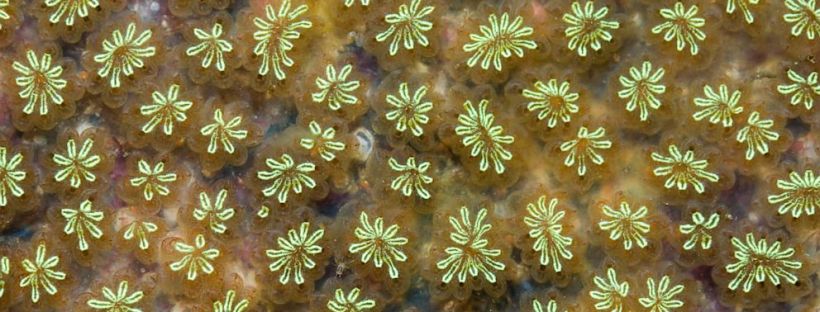
Meet the sea squirt: the golden star, a tiny, unassuming creature that could just be the answer to one of the greatest medical pursuits.
Scientifically termed Botryllus schlosseri, the sea squirt is a type of invertebrate that has a vasculature heart system and bears the most similarities to humans among all invertebrates. It even has 77 percent of genes that are found in humans. It has also been discovered that these marine filter feeders are able to regenerate solely through their blood vessels.
This breakthrough poses a shocking, almost inconceivable possibility: scientists could someday extract the sea squirt’s life saving secret and apply it to humans, allowing an injured person to redevelop a limb or even safely and easily accept a new organ. This life-saving capability is offset by the sea squirt’s destructive behavior.
Also referred to as a tunicate, the sea squirt is known for its tough, tunic-like shell. These creatures breathe and feed through two tube structures called siphons. One siphon takes in water and nutrients and another expels excess water and waste after filtering. If the invertebrate is removed from its underwater environment, it will forcefully eject water from its siphons, hence the nickname “sea squirt.”
Sea squirts can be found just about anywhere in the water, no matter the depth, sometimes attached to coral, rocks or other hard surfaces. These creatures are sessile, meaning they do not move on their own. Rather, they cling to various surfaces, either by themselves or alongside thousands more of their kind. At the most, one can only grow up to a mere four inches in size, but in a colony the sea squirts can cover vast areas together. They are hardy creatures as well, able to survive in polluted waters and in almost any depth.

The fact that sea squirts are so numerous and resilient are one of reasons they are considered dangerous. The colonies can spread out and smother precious sea life such as native plants and animals like crabs and oysters. Originally from Europe, the first sea squirts in the United States were identified in San Francisco during the 1940s. Because they attach to surfaces like boat hulls, they can travel and be introduced to new waters where they can continue to invade. In the Georges Bank of North America, they have covered about seven square miles of seabed.
Baruch College alum Mike Gallardo says, “I think they are very beneficial, especially for people who wear prosthetics or use wheelchairs. But at the same time we definitely need to find a way to secure the waters and save the sea life that the sea squirt is destroying.”
Considering the fact that scientists have discovered genes in the golden star that are key to the development of the heart and vital for vision and hearing, it is likely that the marine animal will continue to be studied. After all, Charles Darwin himself thought these marine filter feeders were pretty special, believing that they would someday reveal how vertebrates came into being through evolution. In his book The Descent of Man, he wrote, “One branch retrograding in development and producing the present class of Ascidians, the other rising to the crown and summit of the animal kingdom by giving birth to the Vertebrata.”
With all the similarities these creatures have with humans, it is highly promising that not only can they possibly answer questions about human existence, they may also strengthen it.
(This article is featured in The Ticker, a Baruch College News Publication.)
Featured Photo: © Getty Images

 Literaria